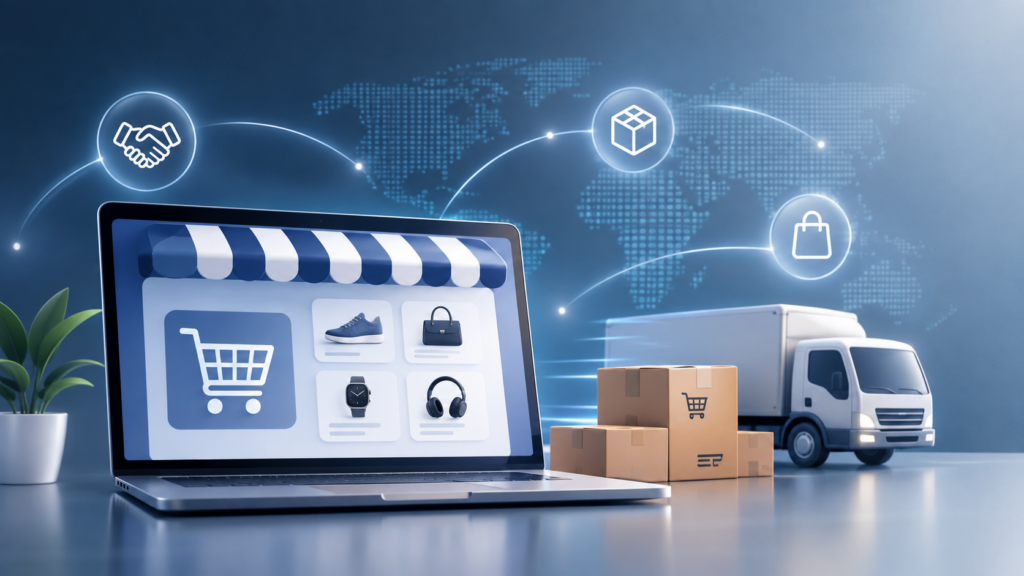
Not every online shop starts with a warehouse. Some of the most practical ways into e-commerce involve selling products you never touch, either by earning commissions on other merchants’ sales (affiliate) or by letting a supplier ship directly to your customer (dropshipping).
WooCommerce supports both, one with a built-in product type and the other with mature extensions. Here is how each model works, what it costs you in responsibility, and how to decide between them.
Two Models, One Big Difference
Both models let you skip inventory. The difference is who the customer actually buys from, and that one difference drives everything else, your margins, your legal obligations, and how much work lands on your desk after the sale.
| Affiliate Shop | Dropshipping Shop | |
|---|---|---|
| Who fulfills the order | The merchant you promote | Your supplier ships directly to the customer |
| Where checkout happens | On the merchant’s site | On your WooCommerce checkout |
| Refunds and returns | The merchant handles them | You handle them, even when the supplier caused the problem |
| You keep | A commission on the referred sale | The margin between your price and the supplier’s cost |
| Setup complexity | Low, no gateway, shipping, or tax setup for the orders themselves | Higher, you run a real store end to end |
| Customer relationship | Indirect, the customer mainly stays with the merchant | Direct, repeat purchases and email lists are yours |
| Risk profile | Close to zero operational risk | Supplier quality, chargebacks, and compliance exposure |
Option 1: The Affiliate Shop
An affiliate shop is simple. Visitors browse your catalog, click a product, and complete the purchase on the merchant’s site through your affiliate link. You never take payment, arrange shipping, or manage returns. You earn a commission for referring the sale.
Why This Works as a First Shop
It removes the heavy operations, no payment gateway, no checkout flow, no shipping zones, no refund handling. What remains is exactly where affiliate shops win or lose:
- choosing products worth recommending,
- writing descriptions that genuinely help people decide,
- building trust with honest comparison content.
Setting It Up in WooCommerce
WooCommerce ships with a product type made exactly for this, the External/Affiliate product. Instead of an “Add to cart” button, the product page shows a button that sends the visitor to the merchant through your affiliate link.
- Go to Products → Add New.
- In the Product data dropdown, choose External/Affiliate product.
- Paste your affiliate link into the Product URL field.
- Set the Button text to something honest like “Buy at [Merchant]”.
- Publish like any normal product. Images, categories, descriptions, reviews, and search all work as usual.
The Disclosure Rule Is Not Optional
If you earn a commission on a link, you must say so, clearly and where people can see it, not buried in a footer. In the US the FTC requires a “clear and conspicuous” disclosure of the material connection, and it has pursued both merchants and affiliates over missing ones. In the EU, the Omnibus Directive backs the same transparency requirement with fines that can reach 4% of annual turnover.
A short, plain sentence is enough:
We earn a commission if you buy through links on this page.
Place it near the product description or right next to the “Buy at…” button. In our experience this does not hurt conversions. Readers already assume it.
Option 2: The Dropshipping Shop
A dropshipping shop is a real WooCommerce store, catalog, cart, checkout, payment gateway, order emails, all of it. The only outsourced part is fulfillment. When an order comes in, it gets forwarded to the supplier, who packs and ships under your store’s name. The flow looks like this:
- The customer orders on your WooCommerce checkout.
- Your store forwards the order details to the supplier, ideally automatically.
- The supplier ships directly to your customer.
- The customer expects support from your store if anything goes wrong.
What “Merchant of Record” Means in Plain English
This is the part most “start dropshipping today” guides skip. Because the customer buys from you, you are generally responsible for:
- payment disputes and chargebacks,
- refunds and returns, even when the supplier caused the problem,
- consumer-law compliance in the regions you sell to,
- VAT and sales-tax obligations on your sales, especially in the EU.
Your margin, typically far higher than an affiliate commission, is payment for carrying exactly this responsibility.
Automation Options
Dropshipping only works when the order flow is automated, because manually re-ordering every sale from a supplier does not scale. A few established WooCommerce paths:
- WooCommerce Dropshipping, the official extension on the WooCommerce Marketplace, built by OPMC. It imports products from AliExpress via a Chrome extension, syncs inventory, notifies suppliers automatically with a PDF packing slip, and also supports Amazon affiliate products, so you can run both models in one store.
- AliDropship Woo, a one-time-license plugin focused on AliExpress, with automated ordering and inventory updates.
- Spocket, which sources from US and EU suppliers, worth a serious look if your customers are in Europe and delivery times matter.
- Printful, for print-on-demand. Your designs on shirts, mugs, and posters, printed and shipped per order from US and EU facilities. A special case of dropshipping where the “product” is actually yours.
Pick based on where your customers are, the shipping times you can honestly promise, how much automation you need, and how you want the packaging branded, which brings us to the next point.
Your Products, Your Brand
Dropshipping does not have to mean selling anonymous catalog items. Several schemes let you put your own brand on the products and the parcels.
- White-label. The package your customer receives carries no supplier branding. Printful operates fully white-label, and you can add your logo to the shipping label, customize the packing slips, and even put your own labels inside the garments. Spocket suppliers increasingly offer the same, custom packaging, inserts, labeling, and branded invoicing.
- Private-label. One step further, the supplier manufactures a standard product under your brand name.
For the customer, the shop, the product, and the box all say you, even though you never touched any of them.
Checklists Before You Start
Affiliate Shop Checklist
- Choose products you can confidently explain, not just list.
- Write helpful, original descriptions. Copied content will not rank.
- Use clear affiliate button text, “Buy at [Merchant]”.
- Add a visible disclosure near the product call to action.
- Make the catalog easy to navigate, categories, filters, search.
- Keep the site maintained, security, performance, backups.
Dropshipping Shop Checklist
- Choose suppliers and extensions that match your target regions.
- Plan your refund, return, and support workflow up front.
- Decide in advance how you handle “the supplier caused the problem” cases.
- Verify product quality and real shipping times before scaling.
- Automate order forwarding so no sale needs manual reordering.
- Publish clear policies and communicate delivery timelines honestly.
- Keep the store maintained, backups, security, uptime.
A Recommended Path for Beginners
A pattern that works well is starting affiliate-first and letting real demand decide what you invest in:
- Start affiliate-first with the built-in External/Affiliate product type to see what people actually want.
- Create comparison content and optimize the product pages that get traffic.
- Identify the winners, the products and categories with proven interest.
- Convert the winners to dropshipping (or private label) once demand is real.
WooCommerce makes this unusually painless because both product types live in the same catalog, and the official extension explicitly supports running affiliate and dropshipped products side by side. You are never rebuilding the store, just upgrading the products that earned it.
The Caveats Nobody Puts in the Headline
Neither model is passive income. An affiliate shop with thin, copied product descriptions will not rank and will not convert, the value you add is genuine curation and honest comparison content. A dropshipping shop with an unvetted supplier will generate refund requests faster than sales. And in both cases, the shop is real infrastructure that needs updates, backups, security, and performance care like any other WordPress site.
How can ProWoos help
If you would rather launch the right setup from day one than debug one later, this is the kind of work we do every week:
- WooCommerce store setup, affiliate product configuration, and dropshipping automation
- Compliant disclosure placement and content structure
- Multilingual catalogs for US and EU audiences
ProWoos is part of the Automattic for Agencies program, so official WooCommerce extensions and hosting for your project come through the official channel.
Get in touch and tell us what you want to sell, even if the answer is “nothing I own yet”.